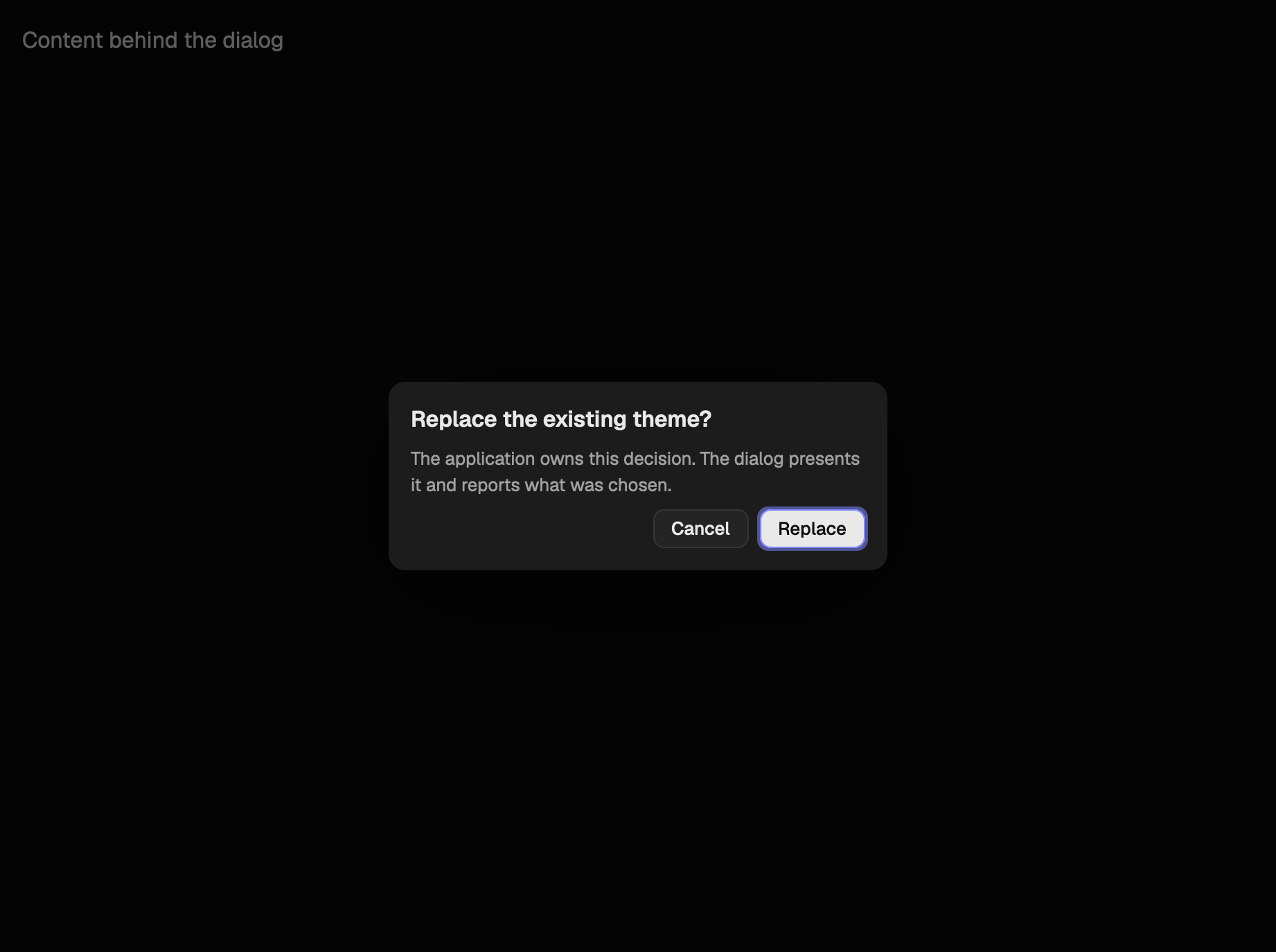
Dialog view
A composed modal: scrim, focus trap, title, body, and up to two actions.
A view survives a frame. Hold it in an Entity with cx.new(..) and reach it with .update(..).
use gpui_kit::overlay::Dialog;Construct
new(ident: impl Into<Ident>, _window: &mut Window, cx: &mut Context<Self>) -> SelfOptions
Chain onto the value.
title(title: impl Into<SharedString>) -> Self
description(description: impl Into<SharedString>) -> Self
content(body: impl Fn(&mut Window, &mut App) -> AnyElement + 'static) -> Self
dismissable(dismissable: bool) -> Self
destructive(destructive: bool) -> Self
confirm_label(label: impl Into<SharedString>) -> Self
cancel_label(label: impl Into<SharedString>) -> Self
Commands
Need a Context, so they need a view.
set_title(title: impl Into<SharedString>, cx: &mut Context<Self>)
set_description(description: Option<SharedString>, cx: &mut Context<Self>)
open(window: &mut Window, cx: &mut Context<Self>)
close(window: &mut Window, cx: &mut Context<Self>)
confirm(window: &mut Window, cx: &mut Context<Self>)
cancel(window: &mut Window, cx: &mut Context<Self>)
dismiss(window: &mut Window, cx: &mut Context<Self>)
Queries
Only answer; they change nothing.
is_open() -> bool
is_dismissable() -> bool
Reports
The variants of the event it emits. It never applies the change itself.
- Opened
- Confirmed
- Cancelled
- Dismissed
- Closed
Rendered by
Each of these compiles and is captured by the gate, so the code behind them is verified rather than written.